Preparation, Patients, and Purpose: Day 4

The first full day in Kathmandu began early. The team was up by 6:00 AM—rested, refreshed, and eager to begin the work ahead.
We have been incredibly blessed by the hospitality and leadership of Kevin Weldon, whose humor and warmth set the tone for the day. Alongside him, Binod Deshar and Daniel Pradhan have been indispensable—coordinating logistics, ensuring we are where we need to be, and taking excellent care of our team.


After breakfast at Soma Cafe, we packed supplies and began the 30-minute commute to the hospital, the facility was originally founded as a leprosy hospital—a powerful reminder of its longstanding mission to serve vulnerable populations.
A Warm Welcome
We were greeted by the Medical Director and Chief Nurse, who expressed deep gratitude for our presence. The Chief Nurse repeatedly gave thanks to God for the timing of our arrival. In response, Dr. Tim Randell shared words of encouragement and purpose, reinforcing why we are here—to serve, to heal, and to honor God through our work.


The team was then welcomed with a traditional Nepali ceremony, where each member received a khada, symbolizing blessing and goodwill.

Preparing the Operating Environment
The morning quickly shifted into preparation mode.
Teams moved efficiently through:
Pre-surgical equipment inspection and testing
Verification of bone cement mixing conditions, ensuring ambient temperatures would support proper curing during procedures
Organization and consolidation of knee implant trials and instrumentation to improve surgical flow, efficiency, and reproducibility
Evaluation and troubleshooting of autoclave sterilization systems


These steps are critical in a mission setting, where variability in environment and equipment can directly impact surgical safety and outcomes.
Clinic Day – Evaluating the Need
The afternoon was dedicated to clinic, where we evaluated 14 patients.
8 patients were identified as surgical candidates for total knee replacement
2 patients presented with post-traumatic arthritis and severe ligamentous instability—cases that exceed the capabilities of our current resources
1 patient had severe shoulder arthritis, which may be addressed on a future trip
1 patient was not a surgical candidate due to uncontrolled eczema, posing an unacceptable infection risk
1 patient had severe deformity beyond what can be safely addressed in this setting


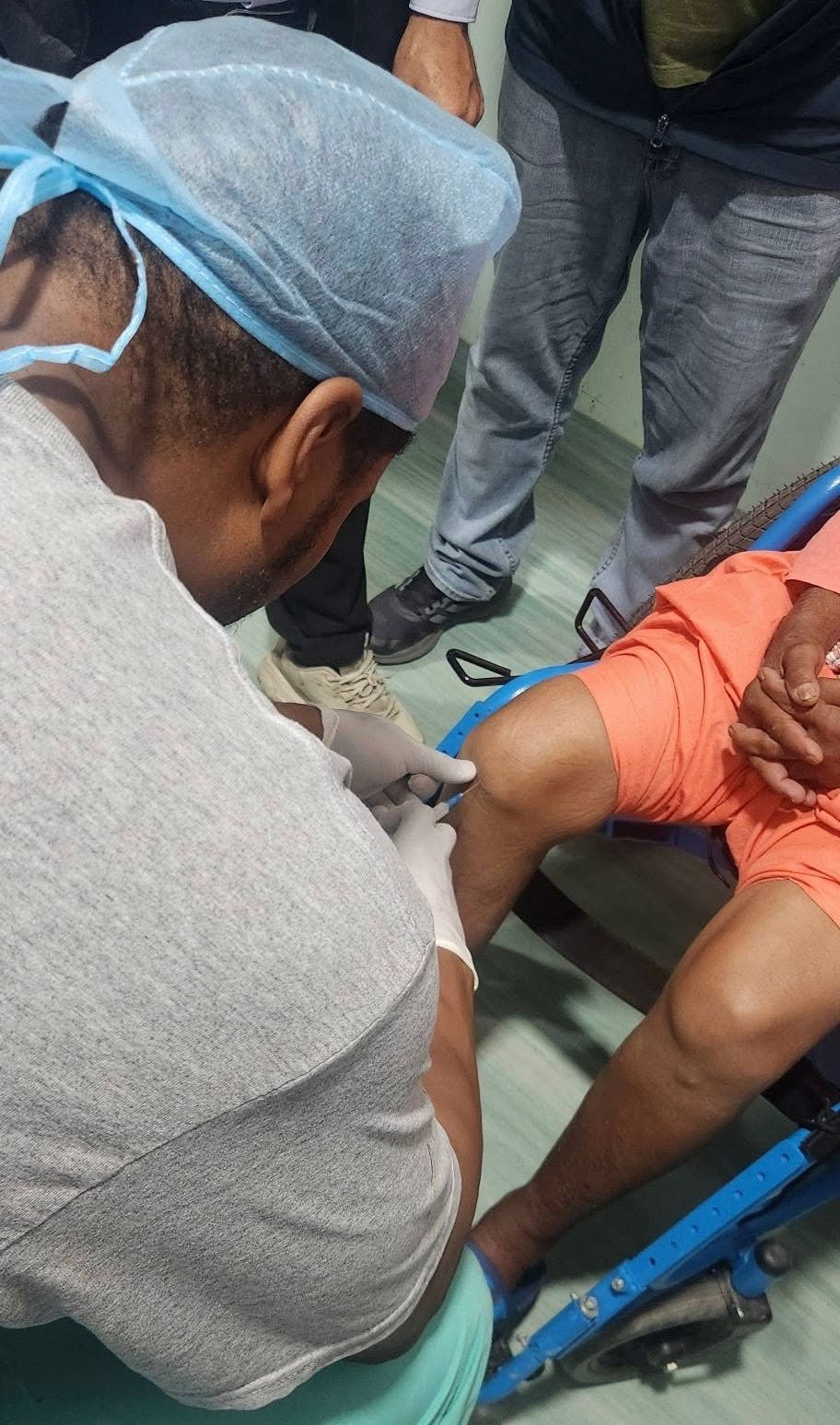
Not every patient can safely undergo surgery in this environment. For those who were not candidates, we focused on alternative care—providing knee bracing, medication guidance, physical therapy recommendations, and in one case, a steroid injection to help manage symptoms and improve function.

We also followed up with several patients from last year’s mission. Their outcomes remain one of the most encouraging aspects of this work—radiographs demonstrated well-fixed implants, with excellent range of motion and function. Four patients have elected to proceed with surgery on the contralateral side, reflecting both trust and meaningful improvement in quality of life.
A Complex Case – Bishal
One of the most impactful encounters today was with Bishal, a 31-year-old man currently in pastoral training with Kevin Weldon.
What initially appeared to be a longstanding injury revealed a far more complex condition after imaging—likely congenital hip dysplasia with complete dislocation, in addition to a tibial nonunion. His case will require thoughtful planning and collaboration with local trauma specialists to determine if future reconstruction is feasible.
Encounters like this highlight the depth of unmet need and the importance of sustained partnerships in global surgical care.
Operational Challenges – Sterilization
As expected in a resource-limited setting, challenges arose.

We continue to experience issues with the autoclave systems. While we are now able to achieve appropriate temperatures, consistency remains a concern. In response, the team has adapted—developing a sterilization protocol using the gravity displacement systems, paired with a multilayer validation process.
Due to time constraints, we were unable to complete a second validation cycle today, so full confirmation of reliability will occur tomorrow prior to surgery.
Despite these challenges, one autoclave remains functional, and the team has successfully prepared and initiated sterilization of surgical instrument sets.
Closing the Day
After a long and productive day, the team shared dinner together at Evoke before returning to the mission house.
The evening concluded with a team devotional led by Jon Cowart, focusing on obedience and the presence and help of the Holy Spirit, drawn from John 14:23–27. It was a meaningful time of reflection—centering the team on faith, purpose, and dependence on God in the work ahead.

The day ended in prayer.
We ask for continued prayer:
For full resolution of the autoclave and sterilization challenges
For safe, successful surgeries and smooth recoveries
And above all, that God would be glorified in everything we do
“Commit to the Lord whatever you do, and He will establish your plans.” — Proverbs 16:3
Tomorrow, we move from preparation to action.
The work begins.


Comments